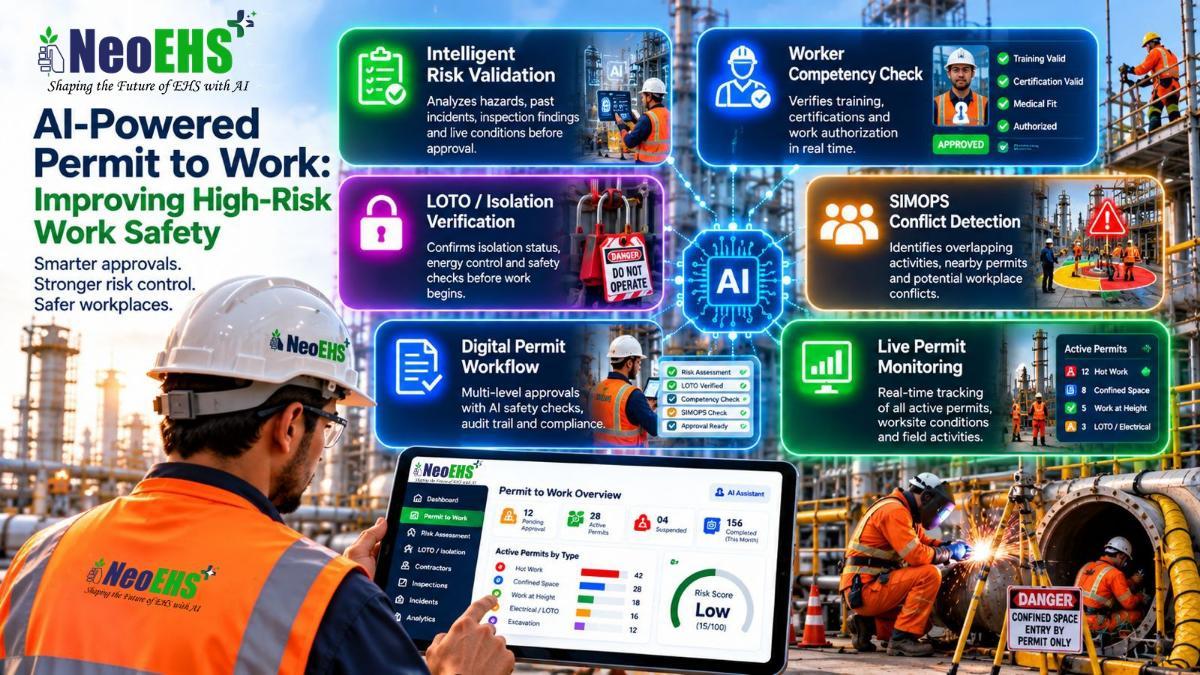
AI-Powered Permit to Work: Improving High-Risk Work Safety
How intelligent risk validation, connected EHS data and real-time monitoring can strengthen control of hazardous work.
AI-Powered Permit to Work: Improving High-Risk Work Safety
A Permit to Work should never become just another form to complete.
In high-risk industries, a PTW represents something much more important: a formal decision that a hazardous activity can proceed because the hazards have been identified, necessary controls have been established, responsible people have been authorized and the worksite is ready.
Yet this is also where traditional permit systems can struggle.
A permit may be correctly completed while conditions at the worksite have changed. A contractor's competency certificate may have expired. An isolation point may not have been properly verified. Two individually acceptable jobs may create a new risk when performed simultaneously. An important corrective action from an earlier inspection may still be open.
Digitizing the permit form solves only part of this problem.
The next evolution is an AI-powered Permit to Work system that connects permits with risk assessments, isolations, contractor competency, inspections, incidents and real-time safety information.
The objective is straightforward:
Before high-risk work starts, give the responsible people better information to determine whether the work is genuinely ready to proceed.
That is the direction behind the NeoEHS Permit to Work Software approach, which combines digital PTW workflows with safety verification, contractor controls, LOTO and connected EHS processes. NeoEHS
What Is an AI-Powered Permit to Work System?
An AI-powered Permit to Work system is a digital work-authorization system that uses connected safety data, intelligent validation, automation and analytical capabilities to help identify missing controls, conflicting activities and changing risk conditions before and during high-risk work.
A conventional electronic PTW may digitize:
Permit request → review → approval → work execution → extension → closure.
An intelligent PTW should go further:
Hazard identification → risk verification → competency check → isolation verification → conflict detection → authorization → active monitoring → worksite verification → safe closure → learning.
The distinction matters.
A digital form makes the permit process faster and more traceable.
An intelligent PTW should make the safety decision surrounding the permit better informed.
AI should support this decision. It should not replace the competent persons responsible for issuing, accepting, supervising or closing permits.
Why Permit to Work Is Critical for High-Risk Activities
PTW systems are particularly important where routine administrative controls are insufficient for the hazards involved.
Depending on the organization and industry, controlled activities may include:
Hot work
Cold work
Confined-space entry
Electrical work
Energized work
Work at height
Excavation
Lifting operations
Equipment isolation and LOTO
Breaking containment or line breaking
Radiography
Pressure testing
Chemical handling
Vehicle entry
Scaffolding
Tank cleaning
Diving or marine work
Blasting
SIMOPS
NeoEHS already supports configurable digital workflows for numerous high-risk permit categories. NeoEHS
But the number of permits an organization processes is not, by itself, an indicator of safety.
The more meaningful question is:
Did the permit process identify the actual conditions that could make the work unsafe?
From Digital PTW to Intelligent Control of Work
Many organizations have already moved from paper permits to electronic systems.
That is valuable. Electronic PTW can improve workflow speed, traceability, standardization and visibility.
But converting a paper permit into a digital form does not automatically make the underlying risk control intelligent.
Consider a hot-work permit.
The form might correctly record:
Work location
Job description
Fire watch
Gas-test results
PPE
Isolation requirements
Responsible persons
Start and expiry times
Everything may appear complete.
But what if another contractor is simultaneously performing an activity nearby that changes the risk?
What if previous inspections repeatedly identified combustible materials in that location?
What if the assigned worker's required certification expired yesterday?
What if a related isolation has not been independently verified?
A traditional workflow may not automatically bring all of this information together.
This is where connected intelligence can strengthen PTW.
How AI Can Improve Permit to Work Safety
1. Intelligent Pre-Permit Risk Validation
One of the most useful applications of AI is before the permit is approved.
Instead of checking only whether mandatory fields have been completed, an intelligent system can evaluate relevant information surrounding the proposed work.
Depending on system configuration and integrations, this may include:
Work type
Location
Identified hazards
Risk rating
Required controls
Previous incidents
Near misses
Inspection findings
Contractor performance
Worker competency
Isolation requirements
Simultaneous activities
Outstanding corrective actions
Suppose a contractor requests a confined-space permit.
The system could help the responsible person identify that the location has previously generated atmospheric monitoring concerns or that a required competency record is no longer valid.
The AI has not made the permit decision.
It has identified information that deserves human attention before authorization.
That distinction is fundamental to responsible AI in safety management.
2. Connecting PTW With Risk Assessment
A Permit to Work should not operate independently from risk assessment.
Before hazardous work begins, the responsible team needs to understand the hazards, controls and residual risks associated with the activity.
Connecting PTW with NeoEHS Risk Management Software can allow relevant HIRA, HIRARC, JSA or JHA information to become part of the authorization process.
NeoEHS's existing PTW platform supports linking permit workflows with operational risk assessments. NeoEHS
This creates an important opportunity.
If the work conditions change, the system can help prompt the team to reconsider whether the original risk assessment remains appropriate.
For example:
Original condition: routine maintenance at ground level.
Changed condition: access now requires temporary work at height.
The permit should not simply continue because it was already approved.
The changed condition may require additional hazard assessment, controls and authorization.
3. AI-Powered Worker Competency Validation
A technically correct permit is not enough if the person carrying out the work is not competent or authorized.
Before permit approval, organizations may need to verify:
Safety induction
Job-specific training
Trade competency
Equipment authorization
Operator licences
Required certifications
Medical fitness where applicable
Contractor authorization
Site-specific competency
Supervisor authorization
NeoEHS already connects worker competency information with PTW and can identify missing or expired requirements during the permit process. NeoEHS
This turns an important question—
"Is this worker authorized to perform this task?"
—from a manual document search into a structured validation step.
This is especially useful on large construction, power, mining, oil and gas, manufacturing, rail and infrastructure projects where thousands of workers and contractors may operate across multiple work fronts.
4. Intelligent Isolation and LOTO Verification
For work involving hazardous energy, permit authorization must be closely connected with isolation control.
Electrical, mechanical, hydraulic, pneumatic, thermal, chemical or stored energy can create severe consequences if isolation is incomplete or incorrectly managed.
An intelligent PTW workflow can help verify configured requirements such as:
Equipment identified → isolation points defined → LOTO applied → verification recorded → responsible persons confirmed → permit authorized.
NeoEHS's current PTW platform includes isolation and LOTO validation as part of its high-risk work-control workflow. NeoEHS
The system can also preserve evidence of verification and authorization for later review.
Technology, however, must never substitute for physical isolation procedures, competent verification or organization-specific LOTO requirements.
5. Detecting Simultaneous Operations — SIMOPS Risk
One of the most valuable future applications of intelligent PTW is the ability to understand interaction between active permits.
Two activities may be acceptable independently but unsafe when conducted together.
Consider these situations:
Hot work near chemical transfer.
Lifting operations above another contractor's work area.
Electrical maintenance while connected equipment is being tested.
Excavation close to underground utilities.
Vehicle movement through a work-at-height exclusion zone.
Confined-space work occurring near another process capable of changing atmospheric conditions.
Instead of assessing permits only individually, an intelligent PTW system can potentially compare:
Activity + location + time + hazard + isolation + nearby permits.
When configured conditions indicate a possible conflict, the responsible safety team can be alerted to review the situation.
This moves PTW closer to dynamic control of work rather than isolated permit administration.
6. Learning From Previous Incidents and Near Misses
Imagine a maintenance team applying for hot work in a particular plant area.
Three months earlier, a near miss occurred there because combustible material had not been adequately removed.
Should that information be visible during the new permit review?
It should.
When PTW is connected with NeoEHS Incident Management Software, previous incidents and near misses can provide valuable context for current work.
Instead of allowing lessons from investigations to remain inside historical reports, connected safety information can help bring relevant experience back into operational decision-making.
This creates an important safety-learning loop:
Incident → Investigation → Root Cause → Corrective Action → Future Risk Assessment → Future Permit.
That is considerably more powerful than treating incident management and PTW as separate systems.
7. Connecting Inspection Findings With Permit Decisions
The same principle applies to inspections.
Suppose yesterday's inspection identified a damaged guardrail on an elevated work platform.
Today, a contractor requests a work-at-height permit for the same location.
A disconnected PTW system may not recognize the relationship.
A connected EHS environment can potentially make the outstanding inspection finding visible during permit review.
This allows the responsible person to ask:
Has this condition been corrected before we authorize the work?
This is one reason an integrated NeoEHS EHS Software platform can provide greater operational value than isolated safety applications. NeoEHS brings PTW, incident management, risk assessment, inspection, contractor management and other EHS workflows into one platform. NeoEHS
8. AI-Powered Contractor Safety Checks
Contractors often perform some of the highest-risk activities at industrial sites.
PTW therefore needs to answer more than:
"Has this contractor been registered?"
Relevant questions may include:
Is the contractor currently approved?
Has the workforce completed site induction?
Are required competencies current?
Are equipment licences valid?
Are required documents current?
Has the supervisor been authorized?
Are there unresolved safety concerns relevant to this work?
Are workers assigned to the permit actually approved for the task?
NeoEHS's PTW platform already incorporates contractor visibility and competency validation into permit workflows. NeoEHS
Connecting contractor safety and PTW reduces dependence on fragmented spreadsheets, emails and paper certificates.
9. Mobile PTW: Taking Authorization to the Worksite
A PTW process loses some of its effectiveness when the permit exists in an office but the hazardous work takes place hundreds of metres away.
Mobile PTW changes this.
Supervisors and safety personnel can perform important workflow activities directly from the field.
NeoEHS currently supports mobile permit approval, QR permit validation, geo-tagged work verification and photo documentation. NeoEHS
This can help establish a stronger relationship between the digital permit and the actual worksite.
For example, field personnel can document isolation evidence or site conditions and verify permit status close to where the activity is being performed.
The aim should not simply be faster approvals.
It should be better verification at the point of work.
10. QR Codes and Digital Permit Verification
Printed permits can become outdated.
A permit displayed at the worksite may have been suspended, extended, modified or closed elsewhere.
QR-based verification can provide workers and supervisors with access to the current permit status where appropriately configured.
A scan might confirm:
Permit number
Activity
Location
Current status
Validity period
Responsible personnel
Relevant authorization status
NeoEHS includes QR-based permit validation within its field PTW capabilities. NeoEHS
This creates a simple but important principle:
The permit being followed at the worksite should reflect the current authorized state of the work.
11. Biometric Verification for Critical Work
For certain high-risk environments, organizations may require stronger identity verification.
NeoEHS has developed PTW capabilities around biometric worker authentication to help organizations verify that the individual associated with an authorization is the person presenting for the work. NeoEHS
Used appropriately, this can strengthen controls for critical activities where worker identity, competency and authorization must be reliably connected.
Biometric deployments should, of course, be implemented in accordance with applicable privacy, employment and data-protection requirements.
12. Real-Time Monitoring of Active Permits
Permit safety does not end when someone presses Approve.
Conditions can change after work begins.
An effective PTW system therefore needs visibility into active work.
Safety teams should be able to understand:
What hazardous work is currently active?
Where is it occurring?
Who is responsible?
Which contractor is involved?
When does the permit expire?
Which isolations apply?
Are there relevant safety alerts?
Are overlapping permits active nearby?
NeoEHS provides centralized live permit tracking, operational status visibility and safety alerts within its PTW solution. NeoEHS
This is particularly valuable during shutdowns, turnarounds and major projects where hundreds of permits may be active simultaneously.
13. Predictive Intelligence for Permit Risk
This is where AI can take PTW beyond workflow automation.
Over time, organizations accumulate significant permit history.
Patterns may begin to emerge.
For example:
One work type repeatedly generates permit deviations.
A particular location experiences more suspensions.
Certain permit combinations frequently require intervention.
One category of work repeatedly produces near misses.
Particular controls are frequently found incomplete during inspections.
Certain contractors generate recurring permit-related findings.
AI-supported analytics can help identify these patterns for review.
The important point is not that AI "predicts an accident."
Safety outcomes are too complex for such simplistic claims.
Instead, predictive intelligence can help identify conditions, combinations and trends associated with elevated concern, enabling competent people to investigate and intervene earlier.
14. AI + Computer Vision for Active Permit Areas
Another emerging opportunity is connecting PTW with computer vision.
Consider a designated hot-work area.
The digital system knows:
where the permit applies,
what activity has been authorized,
when it is valid, and
which controls are expected.
A suitably designed computer-vision system may provide additional information about observable worksite conditions, such as PPE compliance or entry into defined restricted areas.
NeoEHS already supports connections between its PTW environment and AI-powered CCTV safety monitoring. NeoEHS
The long-term opportunity is significant:
Permit authorization + physical worksite verification + real-time safety intelligence.
Computer vision should nevertheless be treated as an additional safety layer. Detection performance depends on factors such as camera placement, visibility and model accuracy and does not replace physical supervision or mandatory controls.
15. Permit Extension, Suspension and Shift Handover
Some of the greatest PTW risks occur not during initial approval, but when circumstances change.
Examples include:
Work continues beyond the original period.
A new shift takes over.
Weather deteriorates.
Equipment status changes.
A process starts nearby.
The work scope changes.
An emergency interrupts the activity.
Isolation conditions are modified.
A mature digital PTW system should therefore manage the entire permit lifecycle rather than simply issuing permits.
Any material change should trigger the appropriate review, revalidation or reauthorization based on the organization's procedures.
An intelligent system can support this by identifying changed information and prompting responsible personnel to reconsider whether the existing authorization remains valid.
16. Safe Permit Closure Matters Too
Closing a permit is not merely an administrative action.
Before returning equipment or an area to normal operation, the responsible team may need to verify that:
Work has been completed.
Personnel are clear.
Tools and temporary materials have been removed.
Guards have been restored.
The worksite has been inspected.
Isolations can be safely removed according to procedure.
Outstanding conditions have been documented.
Relevant operating personnel have been informed.
Digital closure creates a traceable record of these steps.
More importantly, it ensures that the end of the job receives the same disciplined attention as the beginning.
17. Example: How Intelligent PTW Can Prevent a High-Risk Situation
Consider an illustrative example in a power plant.
A contractor requests a hot-work permit for welding maintenance near process equipment.
A basic electronic PTW verifies that all required form fields have been completed.
A connected intelligent workflow could provide additional context:
Risk Assessment: Hot-work hazards and controls confirmed.
Competency: Welder certification valid.
Contractor: Approved for the activity.
Isolation: Required equipment isolation awaiting final verification.
Inspection: A recent housekeeping inspection identified combustible material nearby.
Incident History: A previous near miss in the area involved inadequate hot-work segregation.
SIMOPS: Another contractor has an active permit for nearby maintenance.
Instead of automatically allowing the workflow to continue, the system brings the relevant conditions to the attention of the authorized personnel.
The permit issuer can investigate, ensure the combustible material is removed, verify isolation, review simultaneous work and confirm appropriate controls before authorization.
The AI has not "prevented an accident" by itself.
It has helped ensure that critical information was available at the moment a safety decision was being made.
That is the practical value of intelligent PTW.
18. AI-Powered PTW Across High-Risk Industries
The principles apply across many sectors, although permit types and control requirements differ.
Power & Energy: electrical isolation, high-voltage work, confined spaces, hot work, maintenance and lifting.
Oil & Gas: hot work, line breaking, vessel entry, excavation, process isolation and SIMOPS. NeoEHS's oil and gas platform already combines PTW with isolation control and AI-based permit risk assessment. NeoEHS
Manufacturing: machine maintenance, LOTO, contractor activities, work at height and hot work.
Construction: excavation, lifting, scaffolding, work at height, electrical activities and confined spaces. NeoEHS's construction platform integrates permits with contractor and project safety workflows. NeoEHS
Mining: blasting, heavy equipment maintenance, confined spaces, electrical work and lifting.
Metro & Rail: track access, electrical isolation, maintenance activities, lifting, excavation, work at height and contractor operations.
Ports & Maritime: vessel-related maintenance, lifting, diving, confined-space entry, hot work and cargo-area activities.
The permit system should therefore be configurable around the organization's hazards and control philosophy rather than forcing every industry into the same workflow.
19. What Should an AI-Powered PTW System Include?
Organizations evaluating modern Permit to Work software should look beyond electronic forms.
A strong platform should support:
Capability Safety purpose
Configurable permit types Match workflows to actual hazardous activities
Risk assessment integration Connect authorization with identified hazards
Intelligent safety validation Highlight missing or inconsistent requirements
LOTO/isolation control Strengthen hazardous-energy management
Competency validation Verify appropriately qualified personnel
Contractor integration Control third-party work
SIMOPS awareness Identify potentially conflicting activities
Mobile PTW Bring permit controls to the field
QR verification Confirm current permit status
Geo-tagged evidence Support location-based verification
Active permit dashboard Provide real-time operational visibility
Alerts and escalation Surface conditions requiring attention
Incident integration Apply previous safety learning
Inspection integration Identify unresolved worksite conditions
Audit trail Maintain traceability
Analytics Identify recurring PTW patterns
AI/CCTV integration Add visual monitoring where appropriate
The objective is not simply to digitize permits.
It is to create a connected control-of-work environment.
20. What AI Should Not Do in Permit to Work
AI brings valuable capabilities, but PTW is a safety-critical process.
There must be clear boundaries.
AI should not:
Replace competent permit issuers.
Independently declare hazardous work safe.
Override mandatory isolation procedures.
Ignore engineering controls.
Replace atmospheric testing.
Replace required worksite inspections.
Remove human accountability.
Treat historical correlations as guaranteed predictions.
Instead, AI should help responsible personnel:
find relevant information faster, detect inconsistencies, recognize patterns, identify potential conflicts and make better-informed decisions.
The final authorization for hazardous work remains a human and organizational responsibility.
21. How NeoEHS Approaches Intelligent Permit to Work
NeoEHS treats PTW as part of a wider safety ecosystem rather than an isolated electronic form.
Its existing PTW platform supports digital permit creation, multi-level approvals, LOTO and isolation validation, mobile operations, QR verification, geo-tagged worksite evidence, contractor visibility, permit analytics and integration with risk assessment and other EHS processes. NeoEHS
NeoEHS also connects Permit to Work with capabilities including:
Incident Management
Risk Assessment
Audit & Inspection
Contractor Management
Workforce competency
CCTV safety monitoring
Compliance processes
That connected architecture matters because high-risk work rarely depends on one safety process alone.
A permit may require information from risk assessment, training, contractor management, inspection and isolation management before the responsible person can make a sound authorization decision.
Explore the NeoEHS AI-Powered EHS Platform to understand how PTW fits within a broader connected safety environment. NeoEHS
22. Frequently Asked Questions
What is AI-powered Permit to Work?
AI-powered Permit to Work is a digital work-authorization approach that combines PTW workflows with intelligent validation, connected safety information, automation and analytics to support safer decisions before and during hazardous work.
How can AI improve Permit to Work safety?
AI can help identify missing information, expired competencies, recurring permit issues, relevant historical safety information and other configured risk factors requiring review. Human authorization remains essential.
What is the difference between digital PTW and AI-powered PTW?
Digital PTW primarily replaces paper permits with electronic workflows. AI-powered PTW adds intelligent analysis and connected safety context to help responsible personnel identify conditions requiring additional attention.
Can AI approve a Permit to Work automatically?
For safety-critical work, organizations should maintain appropriate competent-person authorization and governance. AI is better used as decision support rather than as a substitute for accountable permit approval.
Can PTW software integrate with LOTO?
Yes. NeoEHS includes isolation and LOTO validation within its PTW workflows, helping connect hazardous-energy controls with work authorization. NeoEHS
Can PTW software verify contractor competency?
NeoEHS can connect permit workflows with contractor competency, training, certification, induction and authorization information. NeoEHS
Can Permit to Work be managed from mobile devices?
Yes. NeoEHS supports field-based permit workflows including mobile approval, QR verification, geo-tagging and photo documentation. NeoEHS
Which industries benefit from AI-powered PTW?
PTW is particularly relevant to high-risk sectors including power and energy, oil and gas, manufacturing, construction, mining, rail and metro, ports and maritime, chemical processing and infrastructure.
Conclusion: From Permit Administration to Intelligent Work Control
The future of Permit to Work is not simply paperless.
It is connected, risk-aware and increasingly intelligent.
The strongest PTW systems will bring together information that safety professionals previously had to find across multiple systems: risk assessments, isolations, worker competency, contractor compliance, inspections, incidents and active work conditions.
AI can help identify relationships within that information and bring potential concerns to the attention of responsible personnel before and during high-risk work.
But the fundamental principle remains unchanged:
Technology supports the safety decision. Competent people remain accountable for making it.
For organizations seeking to modernize high-risk work control, NeoEHS Intelligent Permit to Work Software provides a digital foundation for connecting permit workflows with broader EHS intelligence.
AI-Powered Permit to Work articleProposed new article: https://www.neoehs.com/blogs/ai-powered-permit-to-work-high-risk-safety
Permit to Work Softwarehttps://www.neoehs.com/solutions/permit-to-work-software NeoEHS
Control of WorkNo dedicated page found — recommended new page: https://www.neoehs.com/solutions/control-of-work-software
LOTO / Energy Isolation https://www.neoehs.com/solutions/loto-energy-isolation-software
Hot Work: https://www.neoehs.com/solutions/hot-work-permit-software
Confined Space: https://www.neoehs.com/solutions/confined-space-permit-software
Work at Heighthttps://www.neoehs.com/solutions/work-at-height-permit NeoEHS
SIMOPS: https://www.neoehs.com/solutions/simops-management-software
Risk Assessment / Risk Managementhttps://www.neoehs.com/solutions/risk-management-software
It is ok to contact this poster with commercial interests.
Call seller