

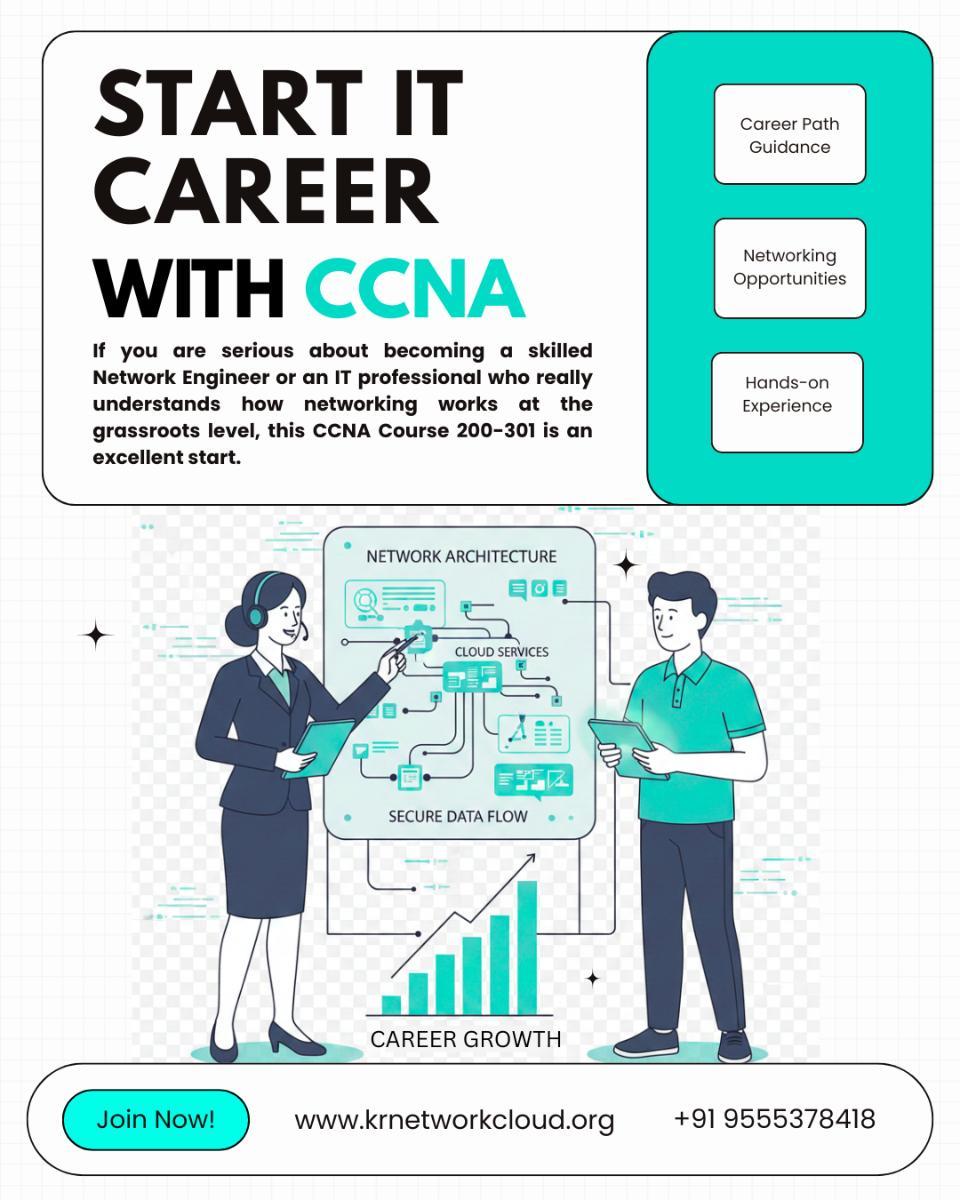
CCNA Course: The Foundation for a Successful Networking Career
**[CCNA Course][1]**
In today’s digitally connected world, computer networks form the backbone of almost every organization. From cloud platforms and enterprise data centers to cybersecurity frameworks and internet services, networking knowledge remains a core IT skill. For individuals aiming to enter or grow in the networking domain, enrolling in a **[CCNA Course][2]** is one of the most effective ways to build a strong technical foundation.
The **Cisco Certified Network Associate (CCNA)** certification by Cisco is globally recognized and widely respected in the IT industry. It validates an individual’s ability to understand, configure, and troubleshoot modern network infrastructures. Whether you are a student, a fresher, or a working professional, a CCNA Course can significantly boost your career prospects.
**What Is a [CCNA Course][3]?**
A **CCNA Course** is a structured training program designed to teach the fundamentals of networking based on Cisco’s official certification curriculum. The course covers essential concepts such as networking models, IP addressing, routing and switching, network security, automation, and troubleshooting.
Unlike basic networking tutorials, a CCNA Course focuses on real-world enterprise networking scenarios. Learners gain both theoretical knowledge and practical skills that are directly applicable to production environments. This makes CCNA one of the most valuable entry-level certifications in the IT networking domain.
**Why a [CCNA Course][4] Is Still Relevant in 2026**
Despite the rapid rise of cloud computing, DevOps, and automation, networking remains a core requirement across all IT roles. Cloud platforms, containers, and microservices still depend on robust network design and security. A CCNA Course helps professionals understand how these technologies communicate under the hood.
**Skills You Gain from a [CCNA Course][5]**
A well-structured CCNA Course equips learners with practical and job-ready skills, including:
- Understanding OSI and TCP/IP networking models
- Configuring routers and switches
- IPv4 and IPv6 addressing and subnetting
- VLANs, inter-VLAN routing, and trunking
- Routing protocols and basic WAN concepts
- Network security fundamentals (ACLs, firewalls, threats)
- Wireless networking concepts
- Network automation and programmability basics
These skills are not limited to Cisco devices alone. The concepts learned in a **[CCNA Course][6]** apply across vendors and platforms, making the knowledge transferable.
**Who Should Enroll in a CCNA Course?**
A CCNA Course is suitable for a wide range of learners, including:
- Students pursuing IT, computer science, or electronics
- Freshers looking to start a career in networking
- System administrators wanting to strengthen networking skills
- Cloud and DevOps aspirants building foundational knowledge
- IT support professionals aiming for career growth
Even professionals with experience benefit from a **[CCNA Course][7]** because it reinforces structured networking concepts that are often learned informally on the job.
**Career Opportunities After a CCNA Course**
Completing a CCNA Course opens doors to multiple entry and mid-level IT roles. Some common job profiles include:
- Network Engineer
- Network Support Engineer
- System Administrator
- IT Infrastructure Engineer
- NOC Engineer
- Technical Support Engineer
With experience and additional certifications, professionals can later move into advanced roles such as network architect, cloud engineer, or cybersecurity specialist.
[1]: https://krnetworkcloud.org/course/ccna-course-in-delhi/
[2]: https://krnetworkcloud.org/course/ccna-course-in-delhi/
[3]: https://krnetworkcloud.org/course/ccna-course-in-delhi/
[4]: https://krnetworkcloud.org/course/ccna-course-in-delhi/
[5]: https://krnetworkcloud.org/course/ccna-course-in-delhi/
[6]: https://krnetworkcloud.org/course/ccna-course-in-delhi/
[7]: https://krnetworkcloud.org/course/ccna-course-in-delhi/
It is ok to contact this poster with commercial interests.
Call seller