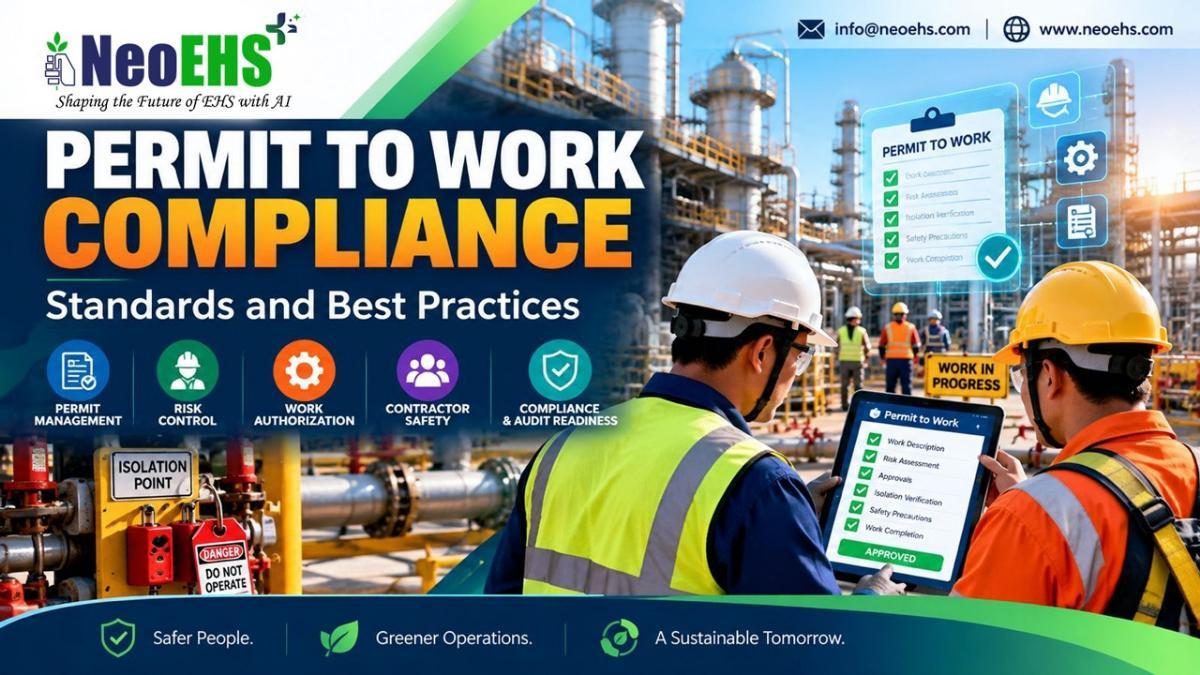
Permit To Work Compliance: Standards and Best Practices
A guide to managing high-risk work, meeting applicable safety requirements, and strengthening work authorization with digital Permit To Work systems.
A maintenance contractor is preparing to enter a vessel at a manufacturing plant. The work has been scheduled, the team has arrived, and production wants the equipment returned to service before the next shift.
The permit form appears complete.
But has the equipment been positively isolated? Has the atmosphere been tested by a competent person? Is the rescue arrangement suitable? Are nearby hot-work activities creating additional hazards? And who will stop the job if conditions change?
These questions illustrate an important principle: a signed permit does not, by itself, make hazardous work safe.
An effective Permit to Work (PTW) system coordinates the people, precautions, authorizations, and operational controls needed to carry out specified high-risk activities.
For organizations managing manufacturing plants, construction sites, power stations, ports, mines, and transport infrastructure, PTW compliance is not simply about maintaining documents. It is about ensuring that hazardous work begins only when the necessary conditions have been established and verified.
This guide explains the relevant standards, common permit types, essential controls, frequent failures, and how digital Permit to Work software can support a more reliable process.
What Is a Permit to Work System?
A Permit to Work (PTW) system is a formal work authorization process used to control specified hazardous activities. It establishes the work to be performed, associated hazards, required precautions, responsible personnel, authorization conditions, and arrangements for completion or handback.
A permit may be required when the potential consequences of an activity justify additional coordination and authorization beyond routine work instructions.
Typical examples include hot work, confined space entry, electrical maintenance, excavation, work at height, and activities involving hazardous energy.
A properly designed system answers six questions:
What work is being performed? Define the task, equipment, location, and scope.
What could go wrong? Identify relevant hazards and interfaces with other activities.
What controls are required? Specify isolations, testing, access restrictions, supervision, and emergency arrangements.
Who is responsible? Identify competent persons authorized to request, review, issue, accept, suspend, and close the permit.
When is work authorized? Establish the validity period, conditions, and reassessment requirements.
How is the work safely completed? Confirm handback, removal of temporary controls where appropriate, and authorization for restoration.
The permit is part of the control system. It does not replace the risk assessment, method statement, isolation procedure, or direct supervision.
Why Permit to Work Compliance Matters
High-risk work frequently involves several departments and contractors. Maintenance may need to coordinate with production, operations, engineering, utilities, and emergency-response personnel.
Without clear authorization arrangements, serious gaps can develop.
A contractor may assume that equipment is isolated because production has stopped. Two work groups may unknowingly perform incompatible tasks in the same area. A permit may remain open after the original conditions have changed.
An effective PTW system helps organizations:
Prevent unauthorized hazardous work.
Clarify responsibilities and approval authority.
Verify that required precautions have been established.
Coordinate simultaneous operations.
Control permit validity, suspension, and handback.
Improve contractor communication.
Maintain evidence for internal review and applicable compliance obligations.
Learn from permit deviations and recurring control weaknesses.
The goal is not to issue more permits. It is to make sure the right activities are controlled through the right level of authorization.
Permit to Work Standards and Regulatory Requirements
One of the most common questions is whether there is a single international Permit to Work standard.
There is no single PTW standard that automatically governs every industry and country. Requirements depend on local legislation, the type of work, sector-specific rules, and the organization's operating conditions.
Several established standards and guidance documents help organizations design and evaluate their systems.
ISO 45001: Occupational Health and Safety Management Systems
ISO 45001 provides requirements for an occupational health and safety management system.
Although it is not a dedicated PTW technical standard, its requirements concerning hazard identification, risk assessment, operational planning and control, contractor coordination, competence, and continual improvement are relevant to permit-controlled work.
A PTW process can form part of the operational controls used to manage identified OH&S risks.
However, using digital PTW software does not automatically establish conformity with ISO 45001 or guarantee certification.
UK HSE HSG250: Guidance on Permit-to-Work Systems
The UK Health and Safety Executive's HSG250, Guidance on Permit-to-Work Systems, is an established reference for petroleum, chemical, and related industries.
It discusses the organization and management of permit systems, including work planning, risk assessment, competence, monitoring, audits, and reviews.
Although developed for particular industrial settings, its principles can inform PTW design in other sectors when appropriately adapted.
OSHA Requirements in the United States
In the United States, specific Occupational Safety and Health Administration requirements apply to particular hazardous activities.
For example:
29 CFR 1910.146: Permit-required confined spaces in general industry.
29 CFR 1910.147: Control of hazardous energy, commonly known as lockout/tagout.
29 CFR 1910.252: Fire prevention and protection requirements relevant to welding and cutting.
29 CFR 1926 Subpart AA: Confined spaces in construction.
These provisions do not create a universal requirement to use one PTW form for every hazardous task.
Organizations must identify the provisions that actually apply to their activities.
Malaysia: DOSH and Applicable Safety Legislation
In Malaysia, organizations should evaluate their duties under the Occupational Safety and Health Act 1994 (Act 514), as amended, relevant subsidiary regulations, and applicable Department of Occupational Safety and Health (DOSH/JKKP) guidance.
Particular activities, including confined space entry, may be subject to additional requirements and industry-specific codes of practice.
A digital permit process should be configured around those obligations rather than assuming that one international template satisfies every Malaysian workplace.
Other Sector-Specific Requirements
Additional requirements may apply in mining, maritime operations, electrical installations, construction, rail infrastructure, and energy facilities.
A reliable compliance approach therefore begins with a legal and technical requirements review for each jurisdiction and operation.
Best practice: Maintain a clear distinction between mandatory legal obligations, recognized standards, industry guidance, and company procedures.
Common Types of Permit to Work
Not every workplace needs the same permit categories. The permit structure should reflect the organization's risk profile.
Permit type Typical activities Key control considerations
Hot work Welding, cutting, grinding Combustibles, fire prevention, atmosphere, fire watch
Confined space entry Vessel, tank, pit, or chamber entry Isolation, atmospheric testing, ventilation, attendant, rescue
Electrical work Maintenance of electrical installations De-energization, isolation, verification, authorized personnel
Work at height Roof work, elevated maintenance Fall prevention, access, rescue planning, dropped objects
Excavation Trenching, underground works Buried services, ground stability, access, adjacent activities
Lifting operations Complex or high-risk lifting Lift planning, equipment suitability, exclusion zones
Line breaking Opening process piping Pressure, temperature, hazardous substances, isolation
General high-risk maintenance Nonroutine equipment work Task-specific hazards, energy control, interfaces
Some organizations use a general work permit with additional certificates or task-specific authorizations.
Others use separate permit categories.
The important requirement is that the system clearly identifies all necessary precautions without creating conflicting or duplicated approvals.
The Permit to Work Lifecycle: Eight Essential Stages
1. Plan the Work
Define the work scope, equipment, location, workforce, timing, and expected operational interfaces.
Check whether the activity requires a permit and whether other permits or certificates must be coordinated.
2. Assess the Risks
Conduct an appropriate risk assessment, such as HIRA, HIRARC, JSA, or JHA, using the methodology required by the organization.
Consider normal conditions, credible deviations, environmental conditions, and simultaneous activities.
3. Establish the Controls
Identify the required engineering, isolation, procedural, access, and emergency controls.
Apply the hierarchy of controls. Personal protective equipment must not be used as a substitute for practicable higher-order safeguards.
4. Verify Site Readiness
Competent and authorized personnel should verify relevant conditions at the worksite.
Examples include isolation verification, atmospheric testing, barriers, equipment condition, and rescue arrangements.
A completed digital checklist is evidence of a recorded verification step, not proof that the physical condition is safe.
5. Review and Authorize
The designated issuing authority reviews the permit conditions and confirms that the required prerequisites have been satisfied.
Approval responsibilities should be separated or independently verified where the risks and operating rules require it.
6. Communicate and Execute
Workers must understand the task, permit boundaries, hazards, controls, stop-work conditions, and emergency arrangements.
The permit should remain accessible as required by site procedures.
7. Monitor, Suspend, or Revalidate
Conditions may change during the job.
A change in work scope, atmosphere, isolation status, weather, adjacent activities, or shift may require suspension, reassessment, revalidation, or a new permit.
An expired permit must not be treated as valid merely because the work is unfinished.
8. Close and Hand Back
Confirm that the work is complete or otherwise left in a controlled condition, personnel are accounted for, and equipment is ready for the appropriate restoration process.
Permit closure and return-to-service authorization must follow the organization's approved procedures.
Ten Permit to Work Best Practices
1. Use a Risk-Based Permit Matrix
Define which tasks require permits, additional certificates, or specialist authorization.
Avoid requiring the same process for every low-risk routine task while overlooking activities with severe potential consequences.
2. Make Responsibilities Unambiguous
Clearly distinguish the permit requester, issuing authority, performing authority, area owner, isolating authority, and other required roles.
Job titles may differ across organizations, but responsibilities must be understood.
3. Link Permits to Risk Assessments
A permit should reference the relevant task risk assessment and controls.
If the work changes, both the assessment and authorization may need review.
4. Verify Hazardous Energy Isolation
Electrical, mechanical, hydraulic, pneumatic, thermal, gravitational, and stored-energy hazards may require isolation or other controls.
Follow the applicable energy-control procedures and verification requirements.
5. Coordinate Simultaneous Operations
Review whether nearby work creates additional hazards.
For example, welding near solvent handling, lifting over active work areas, or excavation beside energized services may require additional restrictions or coordination.
6. Control Permit Validity
Set clear start and end conditions, shift handover arrangements, suspension rules, and reauthorization requirements.
7. Verify Contractor Competence
Check that contractor personnel possess the required training, qualifications, authorizations, and task-specific understanding.
A valid induction record does not establish competence for every hazardous activity.
8. Maintain Effective Emergency Arrangements
High-risk work may require task-specific rescue, emergency communication, firefighting provisions, or standby personnel.
These arrangements should be practicable and understood before work starts.
9. Audit Permit Quality, Not Just Permit Numbers
Review whether permits accurately describe the work, identify relevant hazards, and document effective controls.
Counting completed permits is not a meaningful safety-performance measure by itself.
10. Learn From Deviations and Near Misses
Investigate recurring permit problems, incomplete isolation records, unauthorized work, poor handovers, and failed control verification.
Use findings to improve the system rather than treating every deviation as an isolated paperwork error.
Common Permit to Work Failures
Even mature organizations can experience weaknesses in PTW implementation.
Copy-and-paste risk assessments: Generic hazards and precautions are repeated without considering actual worksite conditions.
Approval without verification: A permit is signed before the required physical controls have been confirmed.
Unclear work boundaries: Workers misunderstand the authorized location, equipment, or scope.
Poor shift handover: Incoming teams do not receive accurate information about permit status and outstanding hazards.
Disconnected isolations: Energy-control records are not adequately coordinated with the authorized work.
Permit overload: Excessive paperwork makes it harder to distinguish significant risks.
Premature closure: A permit is closed without completing the required handback checks.
Weak contractor coordination: Different organizations assume that another party is responsible for critical precautions.
These are management-system problems. Simply converting a paper form into an electronic form will not eliminate them.
How Digital Permit to Work Software Supports Compliance
A digital Permit to Work system can improve the consistency and traceability of work authorization.
Depending on the product and configuration, digital PTW capabilities may include:
Structured permit requests and task-specific forms.
Defined review and approval workflows.
Links to risk assessments and supporting documents.
Permit validity and status tracking.
Mobile access for authorized field personnel.
Evidence attachments and inspection records.
Visibility of outstanding or active permits.
Audit trails and management reporting.
Connections to contractor and corrective-action workflows.
For a plant with multiple maintenance teams, these capabilities can make it easier to understand which permits are awaiting review, which are active, and which require attention.
However, digital approval is not equivalent to physical worksite verification.
A reliable digital process must reinforce—not bypass—the competence, authority, and operational controls required for safe work.
How NeoEHS Supports Permit to Work Management
NeoEHS is an AI-powered Environment, Health and Safety management software platform that includes digital Permit to Work functionality.
Its dedicated Permit to Work Software solution describes capabilities including mobile approvals, QR-based permit verification, geotagged worksite evidence, photo documentation, and connections with related EHS workflows.
NeoEHS also provides a General Permit to Work solution for organizing work authorization processes.
The wider NeoEHS EHS Software platform connects permit management with risk assessment, incidents, inspections, audits, contractor management, and reporting.
Connected Risk Assessment
Linking a permit to relevant risk information can help reviewers understand the identified hazards and required precautions.
Digital Authorization
Defined approval workflows can improve traceability and reduce uncertainty about who has reviewed or authorized a permit.
Field Documentation
Mobile photographs, location information, and permit verification records can support worksite documentation when appropriately configured.
Contractor Coordination
Connections with contractor-related information can help organizations review relevant documentation and responsibilities.
Audit and Management Visibility
Permit records can support internal reviews, investigation of deviations, and identification of recurring authorization problems.
AI-Assisted Compliance Intelligence
NeoEHS describes intelligent validation, automated compliance checks, and predictive risk alerts within its PTW offering.
These functions should be assessed through a demonstration using representative customer workflows. Any AI-generated recommendation or alert must remain subject to competent human review, particularly for safety-critical decisions.
Specific functionality, integration requirements, and deployment arrangements should be confirmed during solution evaluation.
Practical Example: A Hot Work Permit at a Manufacturing Plant
Consider a hypothetical food-processing plant preparing to repair a steel support near an operating production line.
The repair requires welding.
The maintenance supervisor submits a hot-work request, identifying the equipment, location, task, personnel, and proposed work period.
The risk assessment identifies combustible packaging materials, adjacent operations, electrical equipment, and possible exposure to fumes.
Before authorization, the responsible personnel arrange the necessary fire-prevention measures, work-area controls, equipment checks, and emergency provisions.
If required by the site's procedure, a fire watch is assigned.
The issuing authority reviews the conditions and verifies that the necessary prerequisites have been met.
During the work, production plans change and combustible materials are moved closer to the area.
The work must be reassessed and, where necessary, stopped until the controls are restored and authorization requirements are satisfied.
Once the repair is complete, the team follows the required inspection and handback process.
A connected digital PTW system can support documentation, approvals, status visibility, and follow-up throughout this sequence.
It cannot independently determine whether the welding area is safe.
That responsibility remains with competent personnel following the approved work controls.
This example is illustrative and does not represent a claimed customer implementation or measured result.
Permit to Work Audit Checklist
Organizations can use the following questions when reviewing their PTW arrangements.
Audit question Evidence to examine
Are permit-controlled activities clearly defined? PTW procedure and permit matrix
Are authorized roles and responsibilities documented? Role definitions and authorization records
Are task-specific hazards identified? Risk assessments and permit records
Are required isolations verified? Isolation records and field checks
Are simultaneous activities considered? Coordination records and work plans
Are contractors appropriately assessed? Competency and contractor documentation
Are permit validity and handovers controlled? Permit history and shift records
Are stop-work and suspension rules understood? Procedures, briefings, interviews
Is closure and handback properly verified? Completion and restoration records
Are PTW weaknesses reviewed and corrected? Audits, incident findings, CAPA records
A strong audit should include field observation and interviews, not only a document review.
Measuring Permit to Work Performance
Organizations should avoid relying exclusively on the number of permits issued.
More useful indicators may include:
Percentage of sampled permits meeting defined quality criteria.
Percentage of required field verifications completed correctly.
Number and severity of unauthorized-work events.
Repeated isolation or handover deficiencies.
Overdue high-risk corrective actions.
Frequency of permit suspensions caused by changing conditions.
Findings from contractor PTW audits.
Evidence that corrective actions address underlying causes.
These indicators need context.
For example, an increase in recorded permit suspensions may reflect better reporting and stronger stop-work behavior rather than deteriorating safety.
The objective is to understand whether critical controls are working reliably.
Frequently Asked Questions
What is Permit to Work compliance?
Permit to Work compliance means following the applicable legal requirements, operating procedures, authorization rules, and safety controls governing specified hazardous work. It involves more than completing a permit form.
Is a Permit to Work legally mandatory?
It depends on the jurisdiction, industry, and activity. Some regulations require specific permits or formal authorization processes, while other activities are governed by broader risk-control duties. Organizations must identify their applicable requirements.
What is the difference between a work permit and a risk assessment?
A risk assessment identifies hazards, evaluates risks, and determines controls. A work permit authorizes specified work under defined conditions and responsibilities. The two processes should complement each other.
Who should approve a Permit to Work?
Approval should be performed by personnel formally authorized and competent for the relevant work and operating area, in accordance with the organization's procedures and applicable requirements.
What is the difference between Permit to Work and lockout/tagout?
Permit to Work coordinates authorization and controls for hazardous activities. Lockout/tagout is a hazardous-energy control process. A permit does not replace the physical isolation and verification steps required for energy control.
Can Permit to Work be managed digitally?
Yes. Digital PTW systems can support requests, reviews, approvals, documentation, status tracking, and audit trails. They must still preserve required field verification and safety-critical controls.
Does digital Permit to Work software guarantee ISO 45001 compliance?
No. Software can support relevant management-system processes and evidence, but ISO 45001 conformity depends on the organization's implemented OH&S management system.
How does AI help with Permit to Work management?
AI may assist with identifying incomplete information, detecting recurring permit issues, or highlighting conditions that deserve review. Its effectiveness depends on validated capabilities, reliable data, and human oversight.
Which industries benefit from digital PTW?
Manufacturing, construction, power generation, oil and gas, mining, ports, logistics, and transport infrastructure can benefit where their operations involve permit-controlled hazardous work.
What should organizations look for in PTW software?
Evaluate configurable permit types, approval responsibilities, risk-assessment links, isolation coordination, field usability, contractor controls, audit trails, reporting, security, and integration requirements.
Conclusion: Effective PTW Compliance Is About Control, Not Paperwork
A reliable Permit to Work system helps organizations coordinate hazardous activities, communicate responsibilities, verify precautions, and maintain control as conditions change.
Standards and guidance provide a framework, but the effectiveness of PTW depends on what happens at the worksite.
Digital systems can strengthen consistency, traceability, and visibility. AI-assisted features may provide additional support when properly validated.
The essential principle remains unchanged:
Work should begin only when the required controls are established, understood, and verified—and it should stop when those conditions are no longer satisfied.
For organizations seeking to improve their PTW processes, NeoEHS offers connected digital Permit to Work capabilities within a broader EHS management platform.
Explore NeoEHS Permit to Work Software: https://www.neoehs.com/solutions/permit-to-work-software
Website: https://www.neoehs.com/
Email: info@neoehs.com
NeoEHS — Safer People. Greener Operations. A Sustainable Tomorrow.
It is ok to contact this poster with commercial interests.
Call seller